Home birth midwifery · Within an hour of Evanston, IL
Care that has time for you.
The Midwifery Model of Care means value-focused, trauma informed care grounded in current evidence, with a midwife always centering you.
Concierge Midwifery & Birth Support with Heather McCullough, LCPM

4,000+
families supported since 1998
60 min
prenatal visits · first & 36-week visits are 2 hours
Home Birth Team
all your friends
Postpartum with stress removed
no car rides — all in your home
The Midwives Model of Care™
Pregnancy, birth and postpartum are the healthy continuum of life.
As defined by the North American Registry of Midwives (NARM), the Midwives Model of Care includes:
- Monitoring the physical, psychological, and social well-being of the mother throughout the childbearing cycle
- Providing the mother with individualized education, counseling, and prenatal care, continuous hands-on assistance during labor and delivery, and postpartum support
- Minimizing technological interventions
- Identifying and referring women who require obstetrical attention
The application of this woman-centered model of care has been proven to reduce the incidence of birth injury, trauma, and cesarean section.
Source: NARM / Midwifery Task Force.
You are already capable of this.
Good care affirms and helps you feel it.
Two models of care, side by side
| Midwifery model (HMBirth) | Typical obstetric model | |
|---|---|---|
| Visit length | 60 minutes; first and 36-week visits are 2 hours | Often 10–15 minutes |
| Decisions | Informed consent and informed refusal — you decide | Protocol-driven, often by default |
| Evidence | Current research, shared and discussed with you | Varies by practice and policy |
| Trauma-informed | Consent before every touch; your history honored | Varies |
| Who's at your birth | Midwives you know: two midwives at most births, not a midwife and an assistant | Whoever is on shift |
| Postpartum | Home visits at 24–48 hours, 1 week, 2 weeks and 6 weeks | One office visit around 6 weeks |
How it begins
Three steps, no pressure.
1. Free consult
A relaxed call to talk through your hopes, questions and whether home birth fits.
2. Your first visit
Two unhurried hours: your history, your values, and a care plan built around you.
3. Care that continues
Hour-long prenatal visits, your birth at home, and four postpartum home visits.
The evidence
What the research says about home and birth center birth
- Home (MANA Stats, 2014): 93.6% spontaneous vaginal birth, 5.2% cesarean, 87% successful VBAC, 98% breastfeeding at 6 weeks.
- Birth center (National Birth Center Study II, 2013): 6% cesarean, 93% spontaneous vaginal birth, under 2% emergent transfers.
- Birth center (CMS Strong Start): preterm birth 6.3% vs 8.5%, cesarean 17.5% vs 29%, VBAC 24.2% vs 12.5% compared with similar Medicaid births.
- Home + birth center water birth (Bovbjerg, BJOG 2022, 35,060 births): lower odds of neonatal death and 64 fewer postpartum hemorrhages per 10,000 births.
- All 50 states (Birth Place Lab, 2018): better integration of midwives tracks with better outcomes. Illinois ranks low.
Keep exploring
Go deeper on the questions families ask most.
Is home birth safe?
The research, the questions every family asks, what I bring to every birth, and films for the skeptics.
Explore safety →Your care circle
Pediatricians, chiropractors, acupuncture and the organizations I trust with your family.
Meet the circle →Not sure where you want to give birth?
Take the free birth-location quiz from Birth Guide Chicago. It's a comprehensive comparison of home, birth center and hospital options in our area.
Meet your midwife
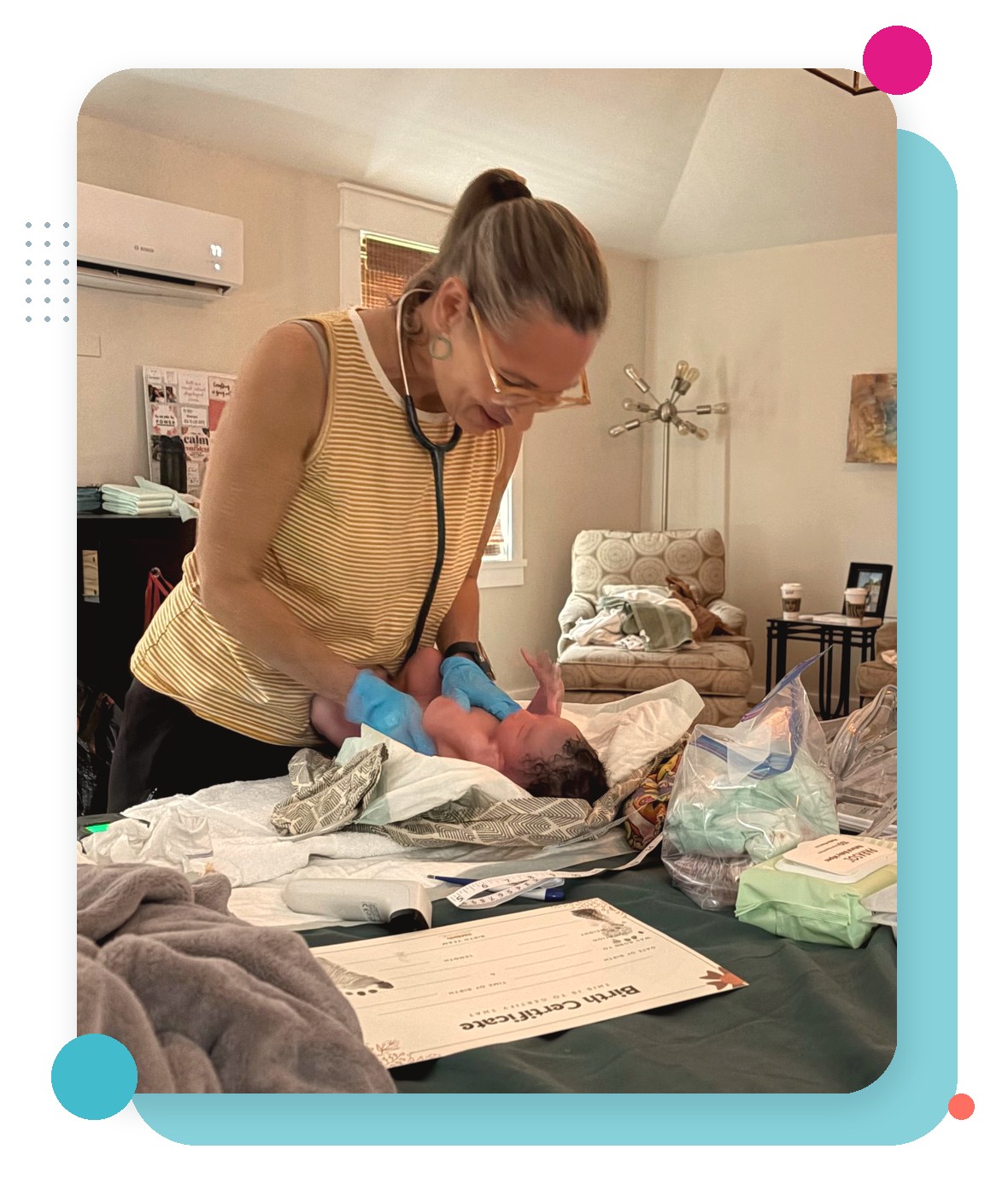
Heather McCullough, LCPM
1998 — Began attending births as a doula.
2001 — Began practicing midwifery at Andaluz Waterbirth Center in Portland, OR.
Today — 25 years as a CPM and 28 years at births, now a Licensed Certified Professional Midwife serving families within an hour of Evanston, IL.
Over 4,000 families later, I still believe the same thing I did at my first birth: you know more than anyone has told you. My job is to bring time, skill and current evidence, and to keep you at the center of every decision.
Every birth begins a new story. I'd be honored to be part of yours.
Insurance & the Illinois Birth Equity Act
Illinois' Birth Equity Act (Public Act 103-0720, HB 5142) requires state-regulated insurance plans to cover services like home birth, midwifery and doula care. That covers roughly 30% of privately insured families; self-funded employer plans follow federal rules and may not be included.
Reporting by WBEZ and the Chicago Sun-Times (October 2026) found the law's early rollout has focused on doulas, with no network adequacy standard yet. State Rep. Robyn Gabel, who sponsored the Birth Equity Act, plans to introduce a bill in January to close those gaps.
Check your coverage in four steps
- Ask your HR department whether your plan is included under the Birth Equity Act (state-regulated) or is a self-funded plan that isn't.
- Ask about coverage for planned home birth with a licensed CPM.
- Ask about out-of-network or gap exceptions if no in-network home birth midwife is available.
- Bring what you learn to your consult and we'll plan together.
Medicaid: I'm in the process of becoming a Medicaid provider. Ask me about it at your consult.
Questions families ask
Is home birth safe?
For healthy, low-risk pregnancies with a trained team and a clear transfer plan, the research shows good outcomes for babies and better outcomes for birthing parents. We screen carefully all through pregnancy and talk openly about any change in risk.
Most families who plan a home birth have one. In the largest U.S. study of planned home births, 89% gave birth at home. For families who have given birth before, it's even higher.
Far fewer interventions. A review of about 500,000 planned home births found that, compared with similar low-risk families planning a hospital birth, families planning a home birth were much less likely to have:
- a cesarean
- a vacuum or forceps birth
- an epidural
- an episiotomy
- Pitocin to speed up labor
- a severe (3rd or 4th degree) perineal tear
- an infection after birth
Labor starts on its own at home, so medical inductions don't happen there. Continuous electronic fetal monitoring and IV-only fluids aren't routine either. Instead, we listen to your baby regularly with a handheld Doppler, and you can eat, drink and move freely.
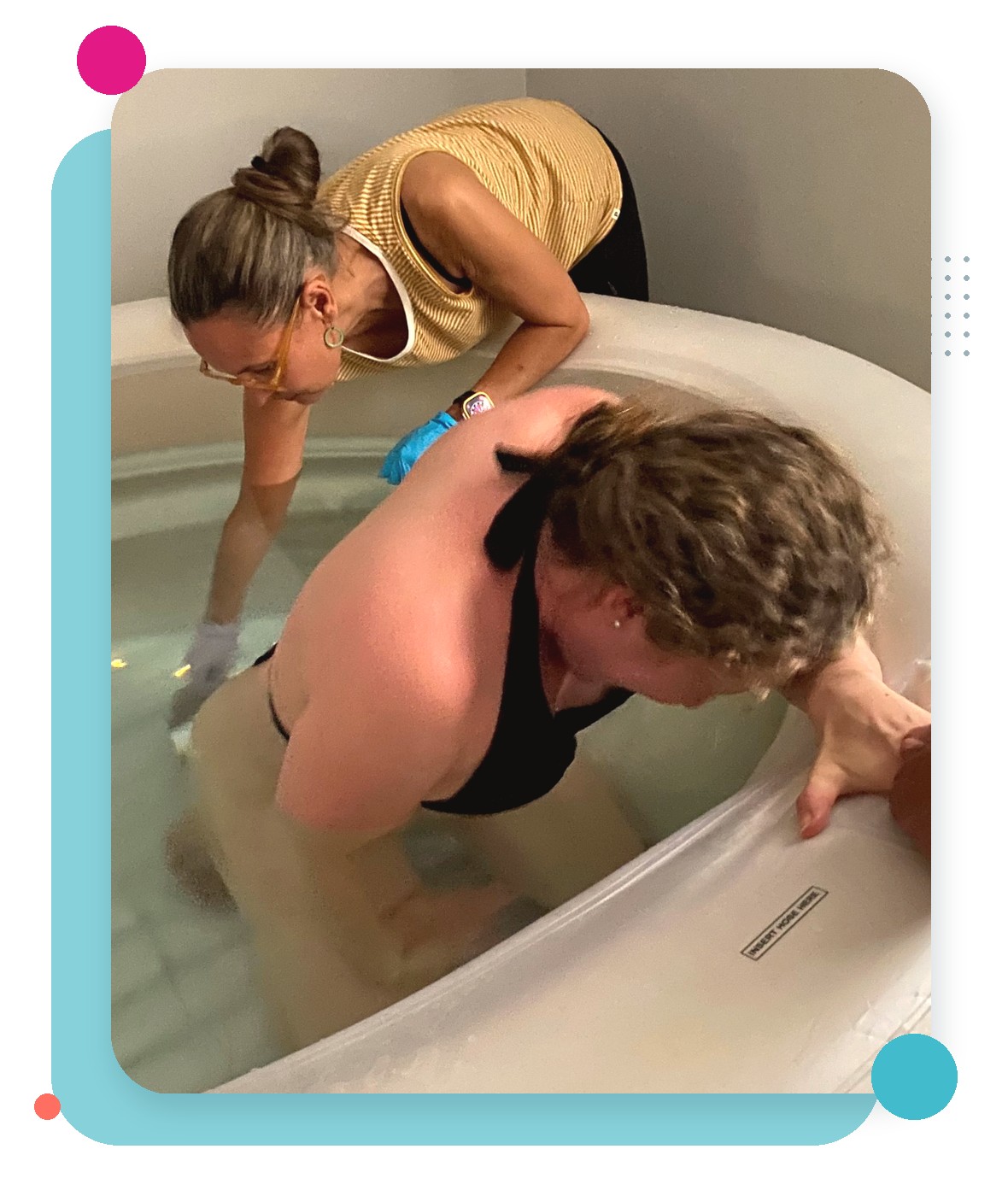
Your family is at the center. Partners often help catch the baby, older siblings can be part of the day, and you make decisions together with your midwife at every step, from your first visit through your six-week postpartum visit.
Sources: MANA Stats 2014; Reitsma et al., EClinicalMedicine 2020.
What do you bring to a birth?
First, I bring joy. After more than 25 years and 4,000 families, every birth still feels like a privilege. I bring calm hands, a steady voice and great vibes. I also bring the skill and experience to know when to simply sit back and let your body do its work, and when to step in.
And we bring bags and bags of equipment: we bring the hospital room to you. That includes:
- Tools to monitor your health and your baby's, such as Dopplers, pulse oximeters, blood pressure cuffs and thermometers
- Two midwives at most births, not a midwife and an assistant, and always at least two NRP-certified attendants, so one can care for you while the other cares for your baby
- Oxygen and newborn resuscitation equipment
- Medications for postpartum bleeding, as allowed by my license
- IV supplies and fluids
- A birth pool and supplies, included with your birth kit at no extra expense
- A transfer plan we've made together, just in case
And skills for the rare, but possible. Our team is trained in shoulder dystocia, breech birth, postpartum hemorrhage and the other birth emergencies that are uncommon but possible, through Birth Emergency Skills Training (BEST) and Mercy in Action's 5-day, hands-on emergency drills for both high- and low-resource settings.
Most of it stays in the bag. That's the point: it's there if we need it, so you can focus on meeting your baby.
What does postpartum care look like?
Home visits at 24–48 hours, 1 week, 2 weeks and 6 weeks. You never have to get in a car after the baby's born.
Where do you serve?
Families within about an hour of Evanston, IL.
What's the difference between a CPM and a CNM?
Certified Professional Midwives (CPMs) are trained specifically in out-of-hospital birth and are licensed in Illinois as LCPMs. Certified Nurse-Midwives (CNMs) are nurses with midwifery training who mostly work in hospitals. You can verify any Illinois midwife's license with the IDFPR license lookup.
Do you accept Medicaid?
Not yet. I'm not currently able to provide care for people on Medicaid, and I'm happy to share referrals.
Let's talk about your birth.
A free, no-pressure consult to see if we're a good fit.